AI-based Eye Inspection for Disease Diagnosis Assistance
Eye inspection, as an essential diagnostic method in traditional Chinese medicine, has a long history and is documented in numerous ancient medical texts such as the "Huang Di Nei Jing - Ling Shu" and "Zheng Zhi Zhun Sheng." Through clinical practice, traditional medicine has accumulated considerable experience in correlating eye signs with various illnesses and developed methods for diagnosing diseases by observing the appearance of the eyes. However, due to the lack of a physical carrier to present eye signs and the absence of an informative and visual representation, the modern application of eye diagnosis has been significantly limited.
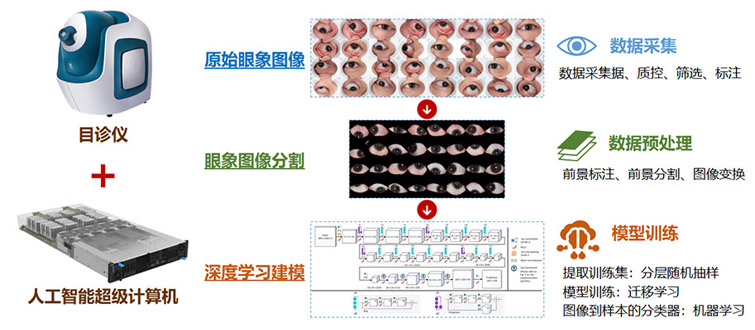
The Eye Health Imaging System (White Sclera Shadowless Camera, hereinafter referred to as the "Eye Diagnosis Instrument") developed by Bio-Technology General Corporation is the world's first equipment for eye diagnosis in traditional Chinese medicine. Based on this instrument, the research institute has developed a deep learning-based method and software system for eye-assisted disease diagnosis, collaborating with several renowned hospitals in China on related research projects.
Among these collaborations, the team worked with Academician Qiao Jie from Peking University Third Hospital on studies for assisting the diagnosis of Polycystic Ovary Syndrome (PCOS) (with a model Area Under the Receiver Operating Characteristic Curve (AUROC) of 0.98) and Gestational Diabetes Mellitus (GDM) (model AUROC=0.84). They also partnered with Academician Shang Hong's team from the First Hospital of China Medical University on HIV infection diagnosis research (model AUROC=0.99). Additionally, the team collaborated with Professor Guo Jiao from Guangdong Pharmaceutical University on diabetes risk assessment (model AUROC=0.91), Professor He Jianxing's team from the First Affiliated Hospital of Guangzhou Medical University on lung cancer diagnosis (model AUROC=0.95), Professor Yu Bo's team from the Second Affiliated Hospital of Harbin Medical University on coronary heart disease diagnosis (model AUROC=0.78), and Professor Hao Dingjun's team from Xi'an Honghui Hospital on osteoporosis diagnosis (model AUROC=0.90).
AI-based Cupping Diagnosis Information System
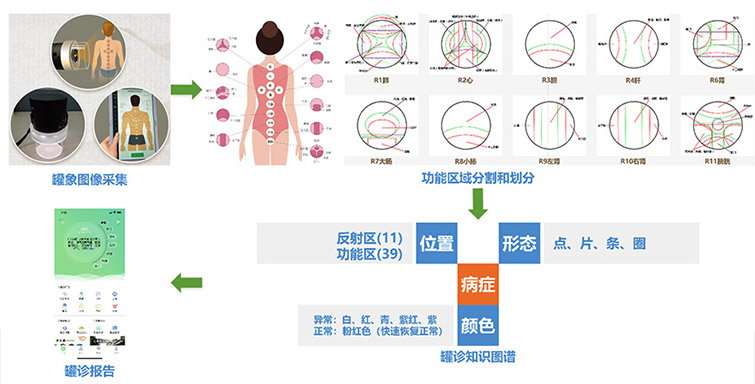
Cupping diagnosis is one of the essential diagnostic methods in traditional Chinese medicine. It involves selecting corresponding functional reaction zones on the reactive points of the governor meridian and bladder meridian on the back, applying cupping therapy, and then assessing the functional state of the internal organs based on the cupping signs formed after five minutes, combined with traditional Chinese medical theories such as cold and heat, deficiency and excess. Based on the cupping instrument developed by Bio-Technology General Corporation, the research institute has developed an AI-based cupping diagnosis information system. This system automatically identifies health status and predispositions to illnesses based on the morphological and color characteristics of the cupping reflection zones and functional areas through image segmentation, generating a cupping diagnosis report.
Emotional Regulation System
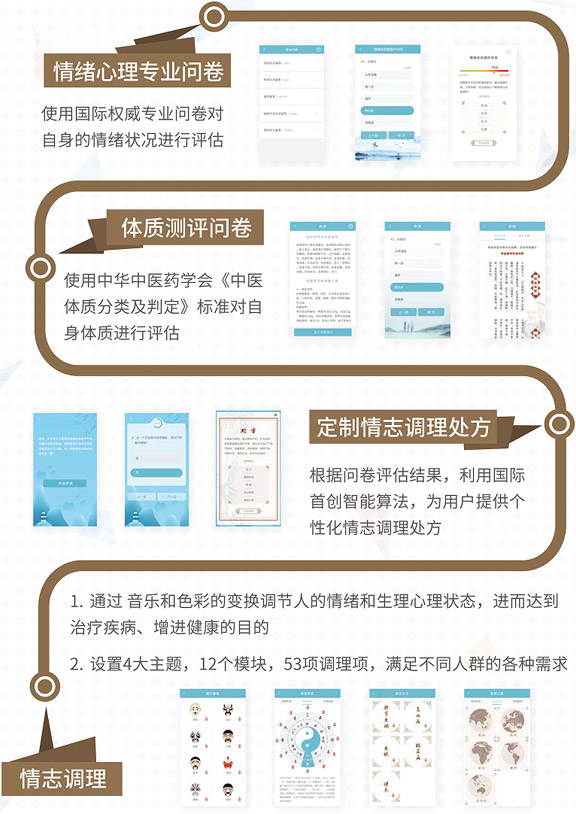
Currently, there are several issues in clinical treatment and health management practices: Firstly, the overemphasis on drug therapy and neglect of non-drug therapies; secondly, the focus on "treating diseases" rather than "treating people," neglecting the psychological aspects and overly focusing on the physical body; thirdly, the lack of scientific and effective "de-medicalized" health management models, products, and services. In response to the national call for vigorously developing non-drug therapies, Bio-Technology General Corporation has developed an emotional regulation system (supporting multiple platforms such as mobile apps, smart screens, and web applications). This system aims to establish non-drug therapies for emotional and psychological regulation, fully leveraging the positive role of culture and arts in disease prevention and treatment, and promoting its nationwide application and demonstration.
The unique features of the emotional regulation system include:
(1) It is the world's first emotional regulation system that integrates art, humanities, psychology, traditional Chinese medicine, brain science, and multimedia, exploring beneficial non-drug treatments for chronic diseases.
(2) It is the world's first intelligent emotional regulation algorithm that integrates color, imagery, music, and blends traditional Chinese medical theories (such as the doctrine of viscera, the five elements, midnight-noon ebb-flow theory, and constitution theory) with Western art psychology (color, music, and emotional regulation theory).
(3) It has established a world-leading knowledge base and multimedia database for emotional regulation, formulated data standards for emotional regulation, and possesses a manually annotated high-definition copyrighted image library of 30,000 pictures and 2,000 music tracks related to emotional regulation, which is continuously updated and expanded.
(4) Created four major emotional regulation modules: emotional adjustment, self-cultivation, music prescriptions, and window to the world. The emotional adjustment module achieves conditioning for eight emotional states including peace, stress, depression, excitement, contemplation, anger, lethargy, and sadness; the self-cultivation module achieves conditioning physical fitness, meridian flow, and balancing the internal organs and other functions; the music prescription module achieves conditioning for spleen and stomach disorders, diabetes, hypertension, insomnia, forgetfulness, Alzheimer's disease, Parkinson's disease and other conditions; the window to the world module realizes functions such as national style, exotic style, and artistic conception association.